The World of Atlantia
Atlantia
From the Chronicles of the Severed Realm
There are many among the younger generations who speak of Atlantia as though it had always existed apart from the Mortal Realm, suspended beyond it in some ancient and immutable separation. I cannot fault them entirely, for no living memory available to most now reaches back far enough to contradict the belief, and the maps upon which they were raised show our realm as though it had never belonged elsewhere. Yet I remember a time before such maps were drawn, when the lands that would one day become Atlantia stood beneath the same heavens as the Mortal Realm and no scholar had need to speak of separation between the two.
The division came not in a single moment of hatred, as later songs sometimes claim, but through a long corruption of understanding. Magic had always inspired awe and fear in equal measure, for mortals seldom encounter power without first attempting to name its danger. There were abuses among the magical kind, certainly, and catastrophes for which no honest historian should excuse those responsible, yet fear grew faster than knowledge, and suspicion proved far easier to preserve than truth. What had once been regarded as strange became forbidden; what was forbidden became feared; and what was feared was eventually hunted. By the final generations before the Severance, concealment had become common, old alliances between magical and mortal families had begun to fracture, and there were regions in which even the rumour of sorcery could condemn an entire household.
It was in that climate that five mages, whose names would later be bound permanently to the history of Atlantia, undertook an act so vast that even now our surviving records struggle to describe it without resorting to language better suited to myth. Their intention, at least in the earliest accounts, was neither conquest nor revenge. They believed that magic, if it remained exposed to mortal fear and political ambition, would eventually be eradicated, corrupted, or forced into such violence that both worlds would suffer for it. Their answer was to remove the lands in which magic still endured most strongly from the Mortal Realm itself and carry them into a parallel reality where magic, those born with it, and the creatures bound to it might survive beyond the reach of mortal persecution.
Thus came the Severance. I have read later histories in which this event is described with admirable neatness, as though entire lands vanished one evening and awoke elsewhere the following dawn. I envy the certainty of those authors. The truth, as I remember it, was far less orderly. Roads ceased to meet the places toward which they had always led. Rivers continued for a time toward valleys that were no longer there. Families discovered that neighbouring lands had become unreachable not through war or distance, but because they no longer occupied the same world. For those left behind, the absence was gradually explained, renamed and forgotten; for those who crossed, no such comfort was possible, because the loss remained visible in every broken road, every displaced border and every memory of a horizon that no longer existed.
From those severed lands emerged what we now call Atlantia. In the centuries that followed, the realm settled into four great territories, each carrying remnants of the world from which it had been taken and each becoming, through time, something altogether its own. I shall not set every one of their histories upon these pages yet. Some records remain closed for reasons greater than the curiosity of the reader, and I have lived long enough to know that knowledge revealed before its proper hour is rarely a kindness.
Celia, however, may be spoken of. Much of the territory once belonged to those mortal lands that would later be gathered beneath the name Europe, and traces of that older world remain embedded throughout it—in its rivers, its forests, its ruined roads and in names whose origins are older than the realm that now preserves them. Celia is a green land, rich in water and woodland, interrupted in the distance by the Celestine Highlands, whose heights rise above the territory like an ancient boundary of stone.
Upon one of their great natural stepping-stones stands Aedon Castle. No institution in Atlantia possesses quite the same purpose. Aedon is the one place to which those born with magic are brought to learn what has awakened within them, to master the gifts that inheritance alone cannot teach them to control, and to understand the laws, histories and disciplines of magic. Some eventually devote themselves to the protection of Atlantia and its people; others remain scholars, dedicating their lives to the study and preservation of magical knowledge. Many paths begin within Aedon’s walls, but all begin with the same necessity: power without understanding is merely danger waiting for circumstance.
I have watched generations arrive at those gates frightened by what they could do and leave years later knowing not only how to wield their gifts, but what kind of mage they intended to become. For that reason, one cannot write honestly of Celia without writing of Aedon. The castle does not govern the territory, nor does it belong to Naucratis, yet its influence reaches far beyond the Celestine Highlands, for almost every trained practitioner in Atlantia has, at one time or another, passed beneath its towers.
These four territories are too often reduced by outsiders to broad impressions of landscape and climate. Such simplifications are convenient for maps and useless for history. Each territory is a civilization in its own right, with cities, rivalries, institutions, customs and memories shaped not only by the land itself but also by the Mortal Realm from which it was taken. The Severance did not erase what came before it. It complicated it.
Indeed, this may be the most enduring truth of Atlantia: we are separated from the Mortal Realm, but we are not free of it. The traces remain everywhere. They survive in language, in architecture, in old territorial records, in family names, in ruins whose construction resembles places that still exist on Earth, and occasionally in mortal stories that describe lands their authors could never have seen. Most scholars prefer to call these similarities coincidence, inherited myth, or cultural residue. All three explanations are sometimes correct. None is sufficient in every case.
I know this because I remember the world before it was divided. There are roads in Celia whose missing continuations I once travelled and names preserved in our oldest records that belonged to places now absent from our skies and maps. Such things are not theories to me. They are memories.
Perhaps that is why I have never regarded Atlantia as a refuge alone. It was a sanctuary, certainly, and without the Severance much of magical civilization may not have survived. Yet every sanctuary is also a separation, and every separation creates two histories where once there was one. The Mortal Realm forgot us; Atlantia did not entirely forget them, and after all these centuries I remain uncertain which of those facts will prove more important.
The Four Territories
The territorial chronicles are unsealed only when their histories have entered the revealed record. Celia is presently open; the remaining three records are still withheld from this archive.
Territorial Chronicle · Unsealed
Celia
The first territorial record presently open within the archive.
Territorial Chronicle
Sealed
This territory has not yet entered the revealed record.
Territorial Chronicle
Sealed
This territory has not yet entered the revealed record.
Territorial Chronicle
Sealed
This territory has not yet entered the revealed record.
The Imperial Domain
Imperial Record
Sealed
The seat of the Empress remains withheld from this archive.
Territorial Chronicle · Unsealed
Celia
Of all the territories of Atlantia, Celia has always seemed to me the most deceptive in its beauty, for there are few lands in this realm that greet the traveller with such tranquillity while concealing so many ages beneath it. It lies near the heart of Atlantia, clothed in forests whose canopies stretch for leagues, crossed by rivers that have shaped the course of settlements since long before the Severance, and scattered with lakes whose still waters have reflected more generations of stars than even our oldest calendars trouble to count. I knew these lands before they were called Celia, when they belonged still to the Mortal Realm and when one might follow roads from these valleys into regions that no Atlantean traveller can reach today. Perhaps this is why I have never been able to look upon Celia solely as it now appears. Where a younger scholar sees a river, I sometimes remember where that river once continued; where a road ends against woodland or stone, I recall that there was an age when it did not end there at all. Time has softened such wounds so thoroughly that most who live here now would scarcely recognise them as wounds, yet to those few of us who remember the world before its division, the older geography has never vanished entirely.
Much of what became Celia once belonged to those mortal lands that later generations would gather beneath the name Europe, and the evidence of that ancestry remains scattered throughout the territory for anyone patient enough to recognise it. It survives not merely in ruins, but in the foundations beneath later cities, in old roads whose original destinations disappeared with the Severance, in fragments of speech whose origins have long been forgotten, and most curiously in names that endured on both sides of the divide. More than once during my studies I have encountered a mortal account describing as myth a place through which I myself had once travelled, and I confess that such discoveries have never ceased to amuse me. Mortals have a remarkable habit of declaring that which they have forgotten to have never existed, while we in Atlantia are perhaps equally guilty of assuming that what we preserved must therefore have remained unchanged. Celia proves both assumptions false. It did not simply survive its removal from the Mortal Realm; over the long millennia that followed, it became something new. Forests reclaimed abandoned routes, rivers altered their courses, settlements vanished while others grew upon their remains, and cities accumulated histories for which no mortal chronicle possesses even a single page. The land remembers its origin, certainly, but it has long since acquired a history belonging wholly to Atlantia.
It is perhaps for this reason that I hesitate whenever visitors describe Celia as peaceful. They are not entirely wrong. There are valleys here in which the only sound at dusk is the movement of water through reeds, woodland paths where generations have walked beneath trees older than their family names, and lakes so calm that one might believe the world had forgotten how to disturb them. Yet tranquillity is not the same thing as innocence, and Celia has never lacked places whose histories sit uneasily beneath their beauty. Abandoned estates remain among fertile lands where no sensible farmer has ever attempted to reclaim them; fragments of walls emerge between roots in forests where no surviving record mentions a settlement; and there are paths that local families have avoided for so many generations that the original warning has disappeared while the custom remains. In my younger centuries I was inclined to regard such traditions as invitations to investigation. Age has made me somewhat less arrogant. I have learned that when a warning survives longer than the explanation that produced it, one would do well to consider that perhaps the people who preserved it knew something worth remembering.
Beyond much of this green territory rise the Celestine Highlands, the great heights of Celia, their elevated masses breaking the horizon above woodland and plain. They are unlike the vast mountain chains described in certain foreign accounts; their character is instead one of immense natural elevations and colossal formations of stone, shaped into terraces and stepping-stones that appear, from a distance, almost too deliberate to have been fashioned by nature alone. Upon one of the greatest of these stands Aedon Castle, and though the castle belongs geographically to Celia, its significance has never been confined to the territory around it. Across all Atlantia there exists no other institution entrusted with the same responsibility, for it is to Aedon that those born with magic are brought to understand the gifts that have awakened within them. Magic may pass through blood and inheritance, but knowledge does not accompany it, and power left without understanding has ruined more lives than any responsible chronicler could comfortably enumerate. Within Aedon’s walls generations of young mages have learned to recognise their abilities, to command rather than fear them, and to study the principles, histories and disciplines through which magical knowledge has been preserved. From there their paths diverge: some devote themselves to the defence of Atlantia and become among those upon whom the protection of the realm depends, while others surrender themselves to scholarship and spend their lives pursuing the understanding of magic itself. I have watched these generations come and go for longer than I care to calculate, arriving uncertain of what they carry within them and departing with the knowledge that power alone does not determine what manner of mage one becomes.
Celia must therefore be understood not merely through its forests, rivers and quiet waters, but through the extraordinary weight of memory carried within them. It is a territory in which the Mortal Realm remains strangely close despite being impossibly distant, where cities can possess histories older than the legends that bear their names on Earth, and where the institution responsible for shaping nearly every trained mage in Atlantia rises above the Celestine Highlands. Its past survives beside its present rather than beneath it, and nowhere is that continuity more visible than in its settlements, where the histories before and after the Severance have accumulated upon the same ground. Of these cities, none has occupied my thoughts more often, nor offered a clearer expression of Celia’s peculiar relationship with memory, than its ancient capital upon Kalos Cliff: Naucratis.
Aedon Castle, Sanctum of Magic
The Celestine Highlands · Celia
Aedon Castle
Sanctum of Magic
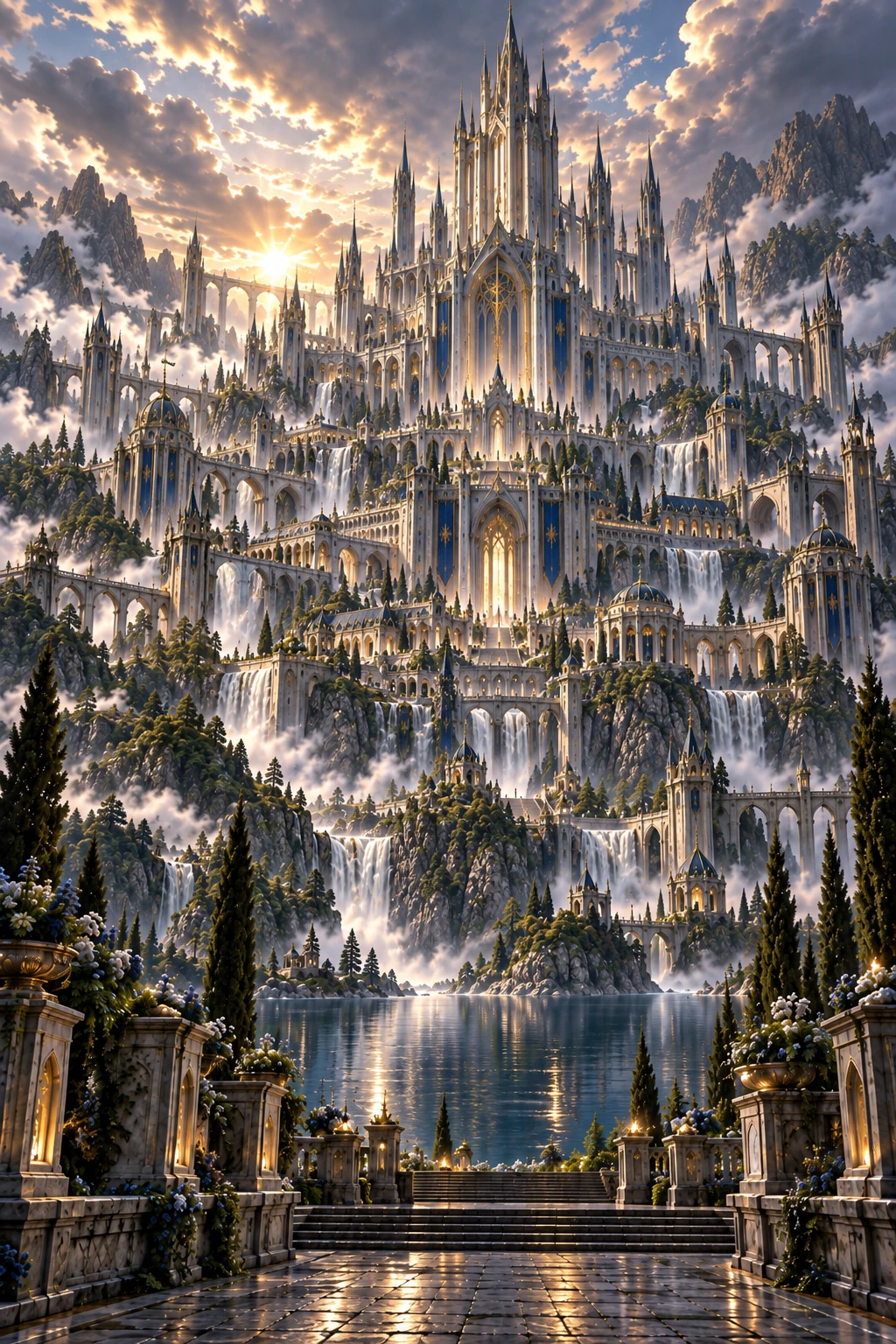
There are places in Atlantia whose greatness was earned slowly, through the long accumulation of centuries, and there are places whose importance was woven into them from the moment their first stones were laid. Aedon belongs to the latter. I have known it longer than most kingdoms have known their own names, and even now, after ages enough to dull lesser memories, I cannot approach it without feeling that I stand once more before one of the first true answers our realm gave to loss. For Aedon was not raised merely as a fortress, nor merely as a seat of learning, but as an act of remembrance and defiance after the fall of the Originals, when the Conclave understood with painful clarity that power alone could not preserve the magical inheritance of our kind unless wisdom, discipline and tradition were also given a sanctuary in which to endure. Thus they raised, upon the great stepping-stone of the Celestine Highlands, the first structure ever built in Atlantia: a citadel not for conquest, but for continuity.
Its situation is worthy of the intention that conceived it. The Celestine Highlands rise above Celia not with the savage violence of broken mountains, but with a grave and elevated majesty, their vast natural shelves and formations of stone seeming almost prepared by the land itself for the thing that would one day stand upon them. Upon one of these immense stepping-stones rests Aedon Castle, lifted above the surrounding forests and valleys with such poise that, from certain distances, it appears less to have been built than to have descended there by ancient design. Below its heights spreads a country of uncommon grace: deep green woodlands murmuring with unseen life, long valleys softened by mist in the morning and gold in the evening, and meadows where strange flowers bloom in forms and colours unknown to any mortal herbarium. Before the castle lies a lake of such depth and clarity that the towers of Aedon seem to continue beneath its surface, as though the water had preserved a second and silent fortress in reflection. Many a young arrival has mistaken that stillness for gentleness, though the wiser among them learn quickly that still waters are often the keepers of the oldest things.
Yet the beauty of the Celestine Highlands has never made them welcoming. The ground upon which Aedon stands is sacred, and whatever power was bound to it in the earliest years of the castle has never permitted the un-gifted to trespass upon it. No commoner may pass into the consecrated reaches of the Highlands, nor set foot upon the lands surrounding Aedon, unless magic already lives within them. I have encountered many theories concerning the nature of this protection and have rejected nearly as many, for no surviving account explains with certainty whether it was wrought by the Conclave, awakened by the land itself, or born from some union of the two during Aedon’s founding. Its judgement, however, has never been ambiguous. Should one without magic attempt to cross the sacred boundary, the land answers before gatekeeper or guard is required: fire rises upon the trespasser with such sudden and merciless force that nothing remains upon the ground where the intruder stood. There are few laws in Atlantia more absolute, and none that require so little enforcement.
For that reason, the sanctity of Aedon has never depended upon walls alone. Its isolation is older and deeper than masonry, preserved by a power that distinguishes those who carry magic from those who do not with a certainty that no scholar has yet learned to imitate. In earlier centuries, several learned men attempted to determine precisely where the sacred boundary began, marking stones, measuring distances and devising instruments of increasingly unnecessary complexity. I knew two of them personally. Both eventually concluded that wisdom consisted less in discovering how close a commoner might safely approach than in accepting that the Highlands had already made their preference sufficiently clear. The records of such experiments remain in the archives, though I have often thought they tell us rather more about scholars than they do about Aedon.
The castle itself bears the authority of antiquity without ever descending into coldness. Its towers rise with solemn elegance above the Highlands, pale stone touched by centuries of weather and light, their lines severe enough to command reverence yet never so harsh as to deny wonder. Bridges, terraces and courtyards bind its many parts into a single whole, while gardens and old walls alike are threaded with the living green of Celia, as though the territory had chosen not merely to host Aedon, but to claim kinship with it. In spring, the scent of wet stone, pine resin and flowering herbs rises from the lower paths; in winter, the air sharpens so cleanly around the battlements that every bell note seems to travel farther than sound ought to go. At dawn the castle is often half-veiled in silver vapour lifting from the lake, and by night its windows shine above the dark waters with a steadiness that has comforted more anxious hearts than any master has ever admitted. Beauty there is never ornamental alone. It is part of the discipline of the place, a reminder that magic was not preserved merely to survive, but to remain worthy of wonder.
Yet no description of Aedon would be honest were it to dwell only upon its appearance. The true greatness of the castle lies in what has occurred within it for generation after generation. It is there, and nowhere else in Atlantia, that those born with magic are brought to understand the powers that awakened within them long before knowledge could guide them. I have seen children arrive at its gates carrying fear like a second shadow, uncertain whether the gifts stirring in their blood were blessings, burdens or omens of ruin. Within Aedon they learn that power, left untended, is often little more than danger in a more beautiful form. They are taught to recognise the nature of their inheritance, to master the instincts and abilities that no untrained life could safely contain, and to study the histories, laws and disciplines through which the magical craft has been preserved from age to age. Some leave its halls called toward the protection of Atlantia, taking upon themselves the grave obligation of defending the realm and the people within it, while others remain in service to knowledge, devoting their years to the study of magic itself so that what was entrusted to one age may not be diminished in the next. In either case, Aedon does more than instruct; it shapes what kind of mage a soul will become.
It would be mistaken, however, to think of Aedon only as a place of lessons. It is, in the truest sense, the living heart of Atlantia’s magical continuity. Within its halls survive traditions older than many dynasties, rites maintained not out of habit but because memory, once neglected, decays with greater cruelty than stone. The Conclave, in founding Aedon, understood that a people who lose the understanding of their own gift will in time lose the gift’s meaning as well. That is why the castle has always stood not merely as a school, but as a guardian of inheritance: a house in which the craft itself is preserved, clarified and renewed whenever history threatens to scatter it. Every corridor, archive, chamber and court bears some trace of those generations who came before, and there are moments, particularly in the quieter hours, when one may feel that the castle is listening as much as teaching, measuring the present against the great invisible company of its past.
For this reason I have never regarded Aedon simply as one landmark among others in Celia, however revered. It is one of those rare places in which history, duty and beauty have been bound together so completely that to speak of one is already to speak of the rest. The forests below it, the strange flowers of the valleys, the deep clear lake before its walls, the austere grace of its towers and the grave labour of those who study within them all belong to a single truth: that after the fall of the Originals, Atlantia did not surrender its heritage to mourning, but answered loss with preservation. Aedon is that answer in stone, guarded not only by those who dwell within its walls but by the sacred land upon which it was raised. And if Naucratis preserves the memory of Celia, then Aedon preserves something perhaps even more perilous and precious—the memory of what magic must remain, if Atlantia is to endure as more than the shadow of what it once was.
Naucratis, Capital of Celia
The Celia Territory · Atlantia
Naucratis
The Crown upon Kalos Cliff
Of all the cities raised upon the territories of Atlantia, few have inspired as much reverence among travellers, historians and rulers as Naucratis, the ancient capital of Celia. I have crossed its bridges beneath summer rain, walked its upper terraces beneath winter mist, and stood more than once upon the heights of Kalos Cliff while the first light of morning broke across the valley of the Achilos. Even now, after centuries that would seem immeasurable to most mortal men, I find it difficult to describe the city without giving the impression that memory has embellished it. Yet Naucratis requires no embellishment. Time itself has already done enough.
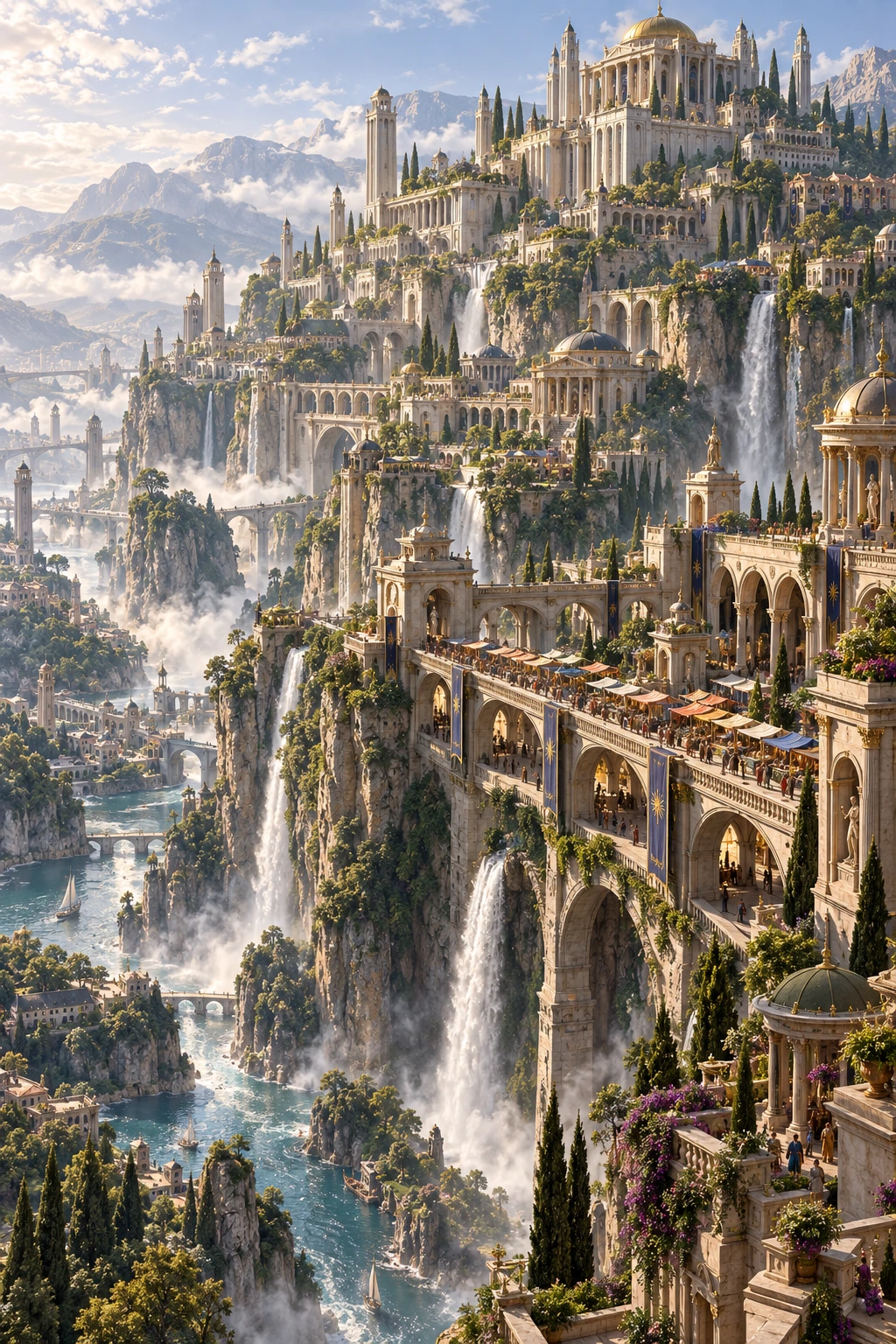
The city rises upon the immense Kalos Cliff, where pale stone and living forest descend together toward the river far below. From a distance, Naucratis appears less to have been constructed than revealed, as though generations of masons merely removed what was unnecessary from the mountain and uncovered a city that had always waited within it. Its halls, towers and colonnades are carved from the rare plinth of Kalos, a stone of pale ivory hue which takes the warmth of sunlight by day and assumes the colour of old bone beneath storm clouds. The oldest structures disappear directly into the cliffside, their chambers extending so deeply into the mountain that even the archivists of the capital possess no complete account of them. Above these ancient foundations rise slender towers, domed halls, ceremonial courts and innumerable terraces, while bridges of astonishing length pass from one rocky prominence to another across chasms filled with mist.
Water has always been as much a part of Naucratis as stone. The highlands above Kalos are rich in springs, and their waters descend through the city in streams, channels and natural falls before plunging from the cliffs into the Achilos valley. Some waterfalls pass beside palaces; others vanish beneath streets only to emerge again several levels below, breaking into silver curtains across the face of the mountain. Their constant murmur may be heard in nearly every district, and in spring, when the waters swell from the distant heights, the entire city seems to speak with their thunder. To those born in Naucratis such sound is scarcely noticed. To the outsider it is often the first thing remembered.
Yet stone and water alone do not give Naucratis its character. The city is green in a manner seldom found among great capitals. Forests rise along the lower slopes of Kalos and continue upward into the inhabited terraces, where cypress, laurel and flowering vines grow between houses, courtyards and sanctuaries. Gardens occupy rooftops and abandoned battlements; ancient trees have been permitted to remain where walls might otherwise have stood, and in some quarters roots older than dynasties have broken through stairs and balustrades without ever being cut away. The old Celian builders understood something that later peoples too often forgot: grandeur is diminished when it attempts to conquer the land upon which it stands. Naucratis was not imposed upon Kalos. It was shaped around it.
The Citadel
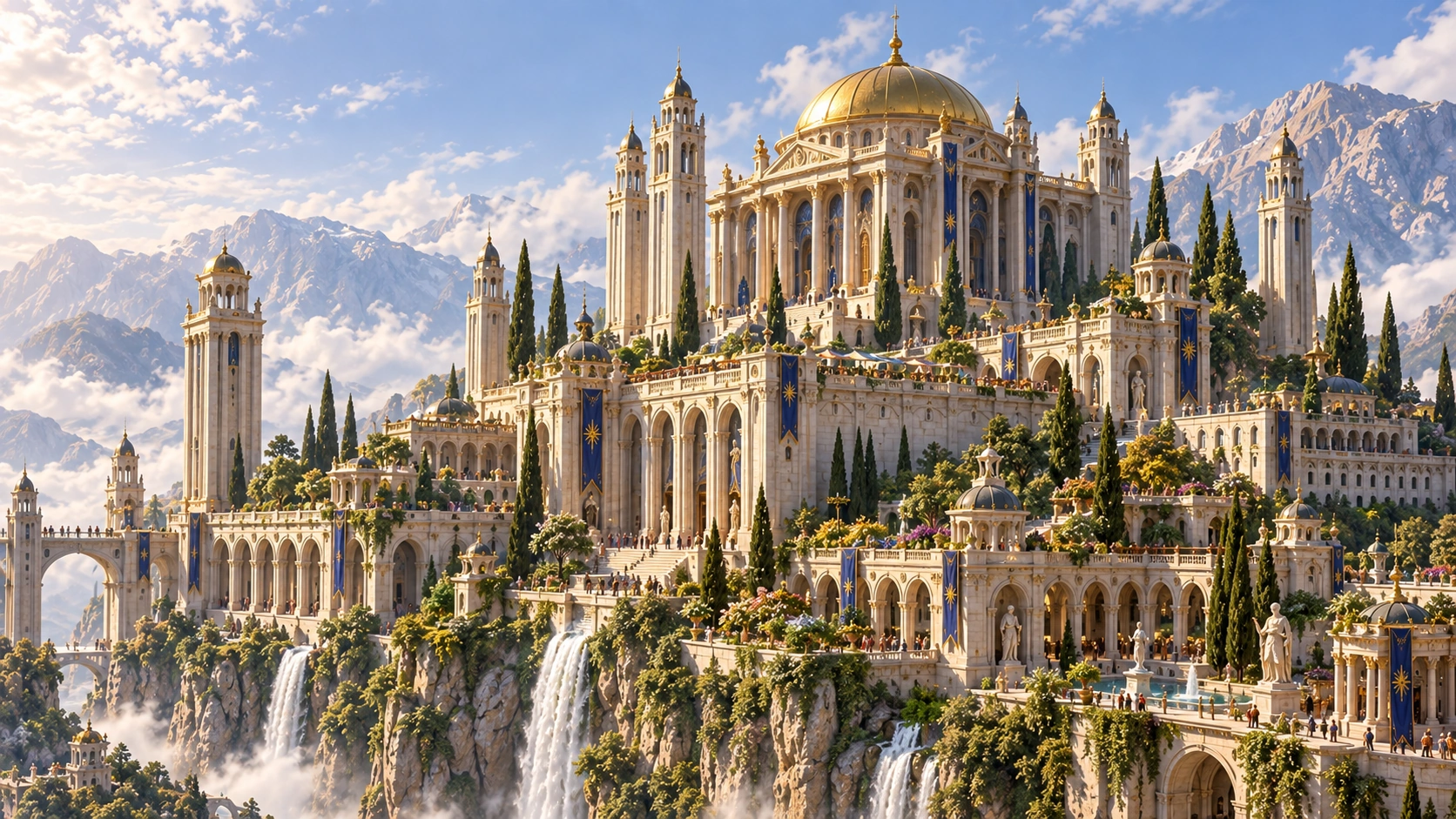
Above the markets, bridges and descending terraces of Naucratis rises the Citadel, crowning the highest reaches of Kalos Cliff. Its great domed hall and slender towers can be seen from almost every district below, emerging above the cypress and pale stone as though the city had gathered its oldest ambitions at the summit. The Citadel has never served a single purpose. Within its upper courts stand the University of Naucratis, the great Archive of Celia, and the chambers of the Celian Committee, whose authority over passage into and out of Atlantia is exercised in the name of the Empress herself.
The University occupies much of the surrounding terraces, its lecture halls, cloisters and libraries woven into the same ancient architecture that once formed part of the earliest fortified heights of the city. For generations beyond easy counting, scholars of history, law, philosophy, medicine, mathematics and the natural sciences have studied within its halls, preserving knowledge brought forward from older ages while adding their own arguments, discoveries and errors to the record. From below, many of its towers appear ceremonial; within them are observatories, collections and private libraries whose contents have outlived several dynasties.
The Archive lies deeper within the Citadel, partly carved into Kalos itself. It preserves the written memory of Celia: records of its cities, treaties, bloodlines, boundaries, judgments, disasters and administrations, together with older documents surviving from the age before Celia was severed from the Mortal Realm. I have spent more years among those chambers than I would willingly admit, and nowhere else have I found so convincing a reminder that kingdoms are temporary things, while a carefully preserved page may outlive them all.
Beside the Archive sit the chambers of the Celian Committee. No lawful passage through Celian jurisdiction into or out of Atlantia is granted without its authority, delegated directly by the Empress. Foreign envoys, scholars, merchants and other travellers may all find themselves before its officials, who are not renowned for haste and even less for being persuaded by impatience. The Committee’s caution is ancient, however, and not without reason. Celia remembers too well what it means for worlds, borders and peoples to be separated without warning.
For this reason, the Citadel has always seemed to me more than the highest district of Naucratis. It is the place where Celia studies itself, records itself, and decides who may cross the boundaries that once divided it from the world it knew before.
The Royal Mile
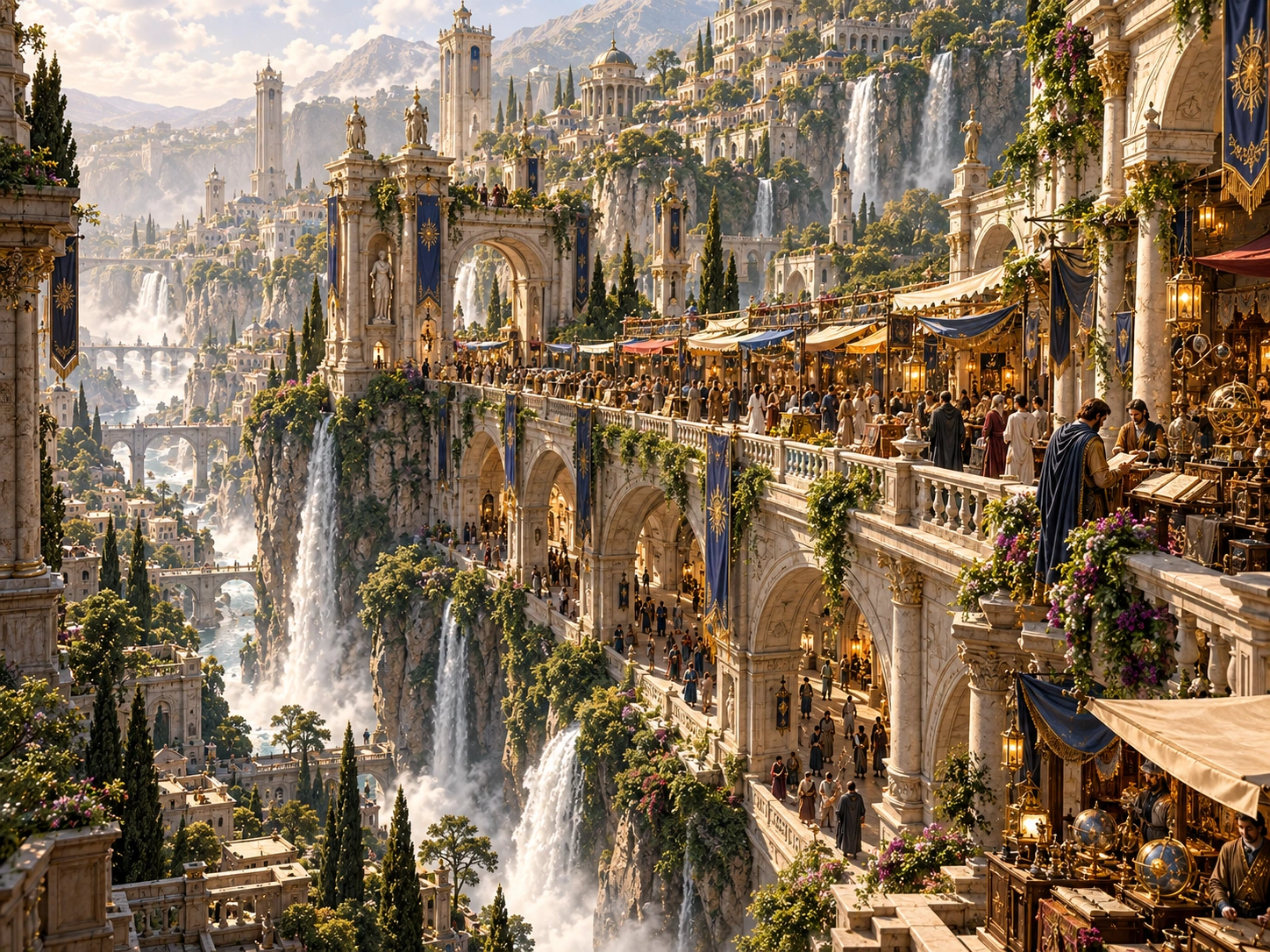
The greatest expression of that union may be found in the Royal Mile, though the name has misled more travellers than I care to count. It is neither a road in the ordinary sense nor merely a bridge, but a vast two-storied thoroughfare spanning one of the principal ravines of Kalos Cliff. Beneath its upper road lie merchants’ halls, store chambers and vaulted passages supported by immense arches; above them stretches one of the most celebrated markets in Atlantia, open to sun, rain and the spray of the waterfalls descending beside it.
I remember the Royal Mile in ages when different crests hung from its towers and its paving stones lay several layers higher than they do now, yet its spirit has altered remarkably little. Spices from distant territories still perfume the arcades. Metalworkers still hammer beneath awnings while antiquarians promise that every cracked tablet in their possession once belonged to a forgotten king. Booksellers guard old manuscripts with greater suspicion than some nobles guard their heirs, and dealers in magical curiosities continue to offer objects of uncertain provenance at prices even less trustworthy than the stories attached to them. At midday the bridge becomes a river of its own: merchants, scholars, travellers, couriers and foreign dignitaries moving above an abyss filled with mist while the Achilos glitters far beneath them.
One may learn much of Celia upon the Royal Mile, and rather more of human nature than many scholars would care to admit.
The City that Descended
It would be easy, from such descriptions, to imagine Naucratis merely as a city of splendour. That would be a mistake. Its magnificence was born not from vanity but from survival, and to understand why the oldest parts of Naucratis occupy the summit while the younger districts descend beneath them, one must look beyond the city and into the earliest history of Celia itself.
There was an age, long before the present ordering of Atlantia, when Celia did not lie where it does now. The oldest records leave little room for doubt: this territory once formed part of the Mortal Realm, among the western lands that mortals would in later ages gather beneath the name Europe. Its mountains belonged to another geography, its rivers crossed lands no longer adjoining them, and its people shared roads and borders with realms whose descendants possess no memory that Celia ever stood beside them.
Much was broken when the territories that would become Atlantia were severed from the mortal world. Borders ceased to meet. Rivers were divided from their former courses. Roads ended where no frontier had once existed, and mortal history continued around the absence until the absence itself became invisible. Celian records, however, preserved another memory. They speak of journeys westward toward countries that appear on no Atlantean map, of mountain chains continuing beyond horizons that no longer belong to the same realm, and of merchants calculating distances to cities whose ruins must now, if they survive at all, lie beneath mortal soil.
For many centuries scholars dismissed such passages as the distortions of antiquity. I confess that in my younger years I was among them. It is an arrogance common to scholars: when an old record contradicts the world we know, we first suspect the record and only much later think to suspect the world.
Age cured me of that particular conceit.
In the archives beneath Naucratis I examined maps drawn before the oldest surviving Celian dynasties and compared them with fragments recovered from the Mortal Realm. I found rivers separated by worlds that nevertheless followed one another too precisely to be strangers. I found mineral strata in Kalos whose continuation ought not to exist anywhere beyond Atlantia, yet whose likeness appears in mortal mountains. Most troubling of all, I found old Celian names lingering in corrupted forms within mortal tales whose tellers had long forgotten what those names once described. After enough such coincidences, a scholar must either alter his conclusions or surrender the right to call himself one.
Naucratis stands at the centre of that forgotten history. The earliest fortifications upon Kalos were raised during the generations surrounding the separation, when Celia found itself cut away from the lands it had known and thrust into a new political order not yet settled. Families climbed toward the heights. Noble houses brought archives, coin and household relics. Priests carried sacred objects from sanctuaries that could no longer be safely maintained. Merchants established storehouses beside military yards, and refugees filled the defensible terraces above the Achilos. A refuge became a fortress; the fortress became a capital; and the capital, given centuries enough, became Naucratis.
This is why the city grew downward rather than outward. Its oldest population occupied the summit, where the cliff afforded protection and command of the valley. As the danger receded and Celia became secure, habitation descended along the rock face. Bridges appeared where once there had been narrow crossings. Markets consumed former defensive yards. Gardens spread across walls that no longer needed to bear soldiers. Thus a traveller climbing Naucratis does something uncommon among cities: with every ascent, he moves further backward into history.
The Memory Beyond Atlantia
Stranger still is what appears to have survived on the other side of the severance. Throughout the Mortal Realm there persist old accounts of cities built upon impossible cliffs, of kingdoms hidden beyond mountains, of bridges hung above falling waters and of lands removed from the world after calamities no historian can place. Most are imperfect things, worn thin by retelling and ornamented by generations who knew neither Celia nor Atlantia. Yet occasionally one encounters a detail too exact to dismiss comfortably.
Many years ago I acquired a mortal manuscript whose author claimed only to have written down a tale heard in childhood from his grandmother. He knew nothing of Naucratis and nothing of Celia. Nevertheless, he described a pale city rising tier upon tier above a blue river, with gardens growing among its towers and water falling from the mountain through the streets. He wrote that the city had vanished from the world and that those who remembered it would one day be thought mad.
He described Kalos Cliff.
I have kept the manuscript ever since. I have also kept it from several colleagues who remain devoted to the comforting doctrine of coincidence. Even after millennia, a scholar must be permitted one or two private amusements.
The Crown that Endures
So Naucratis remains, suspended between the country Celia became and the world from which Celia was taken. Each morning the merchants return to the Royal Mile, barges move along the Achilos, gardeners climb the upper terraces, and water descends from Kalos in paths older than any throne. At dusk the bells of the high city answer one another across the ravines; by night thousands of lamps appear along the bridges and cliffside dwellings until the capital seems less a city upon the mountain than a constellation descending toward the river.
I have seen kingdoms vanish more quickly than some of its trees have grown. I have watched mortal empires divide their lands, rename them, colour them differently upon maps, and assure each new generation that the lines they inherited were permanent. They never are. Naucratis understands this better than most cities, for its very existence is proof that geography may be broken while memory persists.
There are evenings when I stand upon the upper terraces and look toward the west, knowing that beyond boundaries invisible to the eye lies the mortal world from which Celia was severed. In such moments I do not wonder what Atlantia gained when this land became part of it. I wonder instead what the Earth lost without ever understanding that something had been taken away.
And when the clouds gather beneath Kalos until only the oldest towers rise above the mist, I sometimes entertain a thought I have never managed to dismiss: perhaps Naucratis has not spent all these ages waiting to be discovered. Perhaps it has been waiting for the Mortal Realm to remember that it once knew the way.