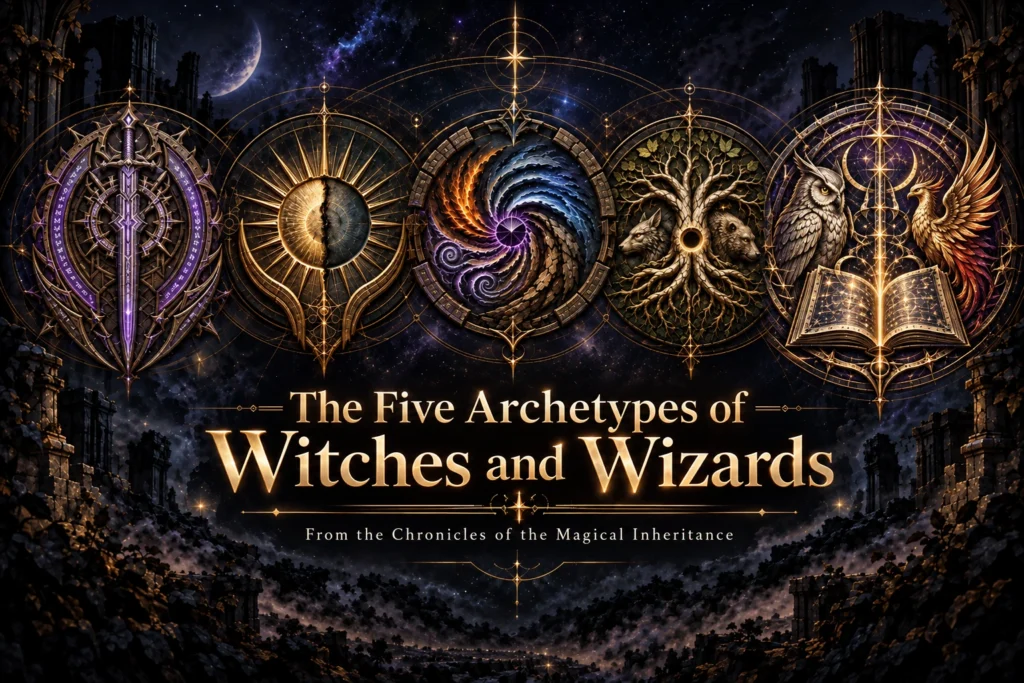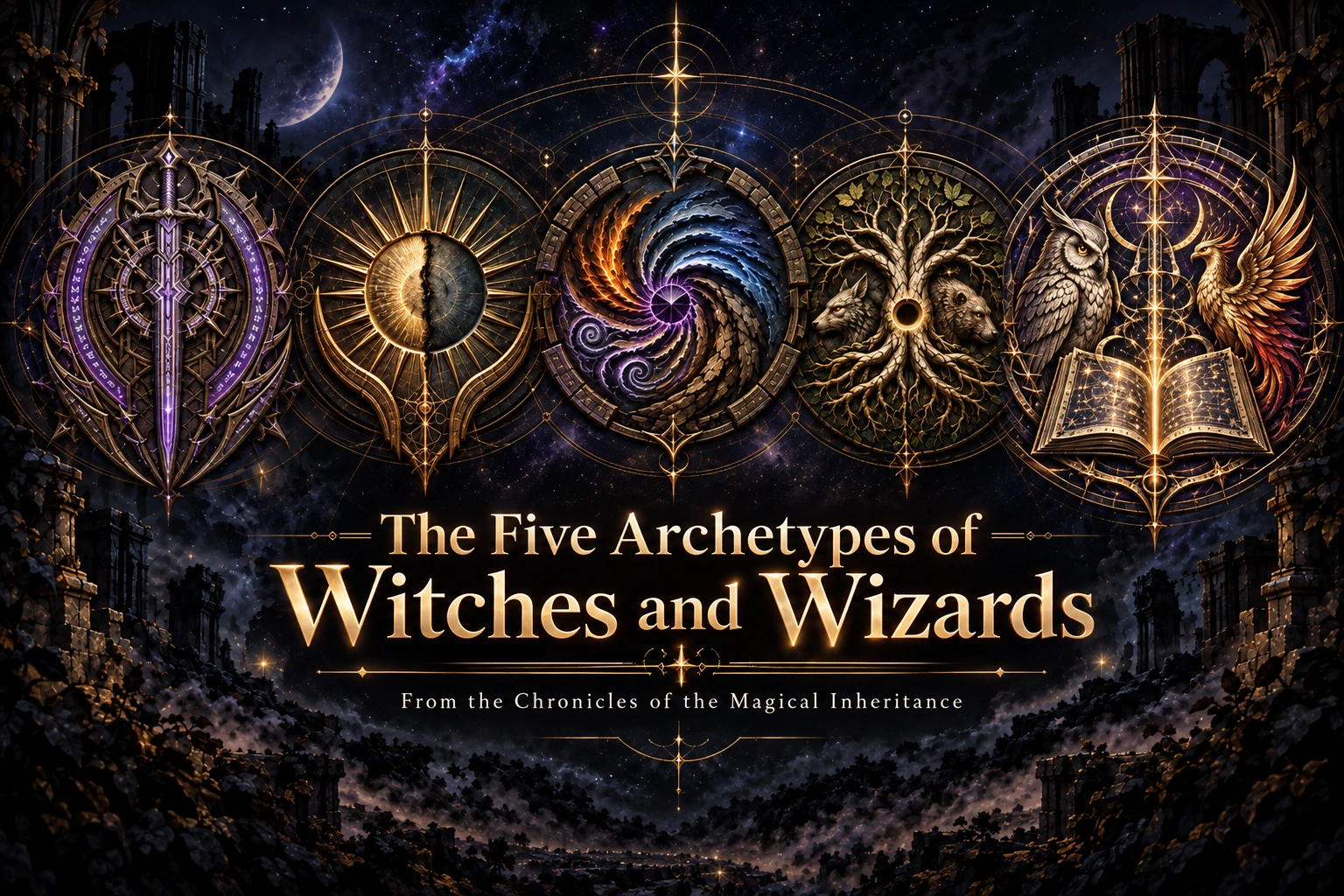
The Five Archetypes of Witches and Wizards
From the Chronicles of the Magical Inheritance
The Nature of the Archetypes
There was a time, long before scholars sought to give names to every branch of the Art, when witches and wizards spoke little of archetypes. They spoke instead of blood, temperament, instinct, and calling. A child who caused the hearth-flame to rise when angered was said to have been favoured by fire; one who heard voices among the trees was entrusted to the old groves; those whose hands closed naturally around a blade were trained for battle, while others were drawn toward shrines, herbs, stars, scrolls, or the care of the wounded. For many centuries such differences were regarded as matters of upbringing, disposition, culture, or chance, and even among the learned there was little agreement as to whether any deeper order existed beneath them. I have lived long enough to remember when such beliefs were taught with absolute confidence, and longer still to watch that confidence diminish as observation yielded what tradition had failed to see.
Magic does not enter the world as an empty force waiting to be shaped wholly by the will of its bearer. It arrives already inclined, though not confined, toward certain expressions, and this inclination belongs neither entirely to blood nor to education. It is something older and more elusive, an affinity impressed upon the soul before the witch or wizard has spoken a spell, held a wand, touched a blade, or learned the first principles of the Arcane. It determines not what a mage is permitted to become, but the manner in which magic most readily answers them, the path along which power moves with the least resistance, and the form through which their inheritance most naturally reveals itself. What later scholars came to call the Archetype was therefore not a discovery in the strictest sense, but merely a name given to a truth that had been present since the earliest ages of magic.
The name itself is younger than the thing it describes. Across the eras, many civilisations recognised portions of the same truth and clothed it in their own language. The oldest covens spoke of the Five Natures; fragments preserved from earlier magical cultures employed terms that might be translated as dispositions, inheritances, or inner paths; later conclaves favoured the expression Arcane Lineages, though that title was eventually abandoned, and wisely so, for an archetype is not a lineage in the ordinary sense. A daughter need not bear the same magical nature as her mother, nor a son that of his father. Entire generations may pass within a family without a particular archetype appearing, only for it to emerge again in a descendant whose abilities seem at first to have no precedent among their kin. Blood may preserve possibility, certainly, but it does not dictate the shape in which that possibility will awaken. This distinction, simple as it now appears, cost our predecessors centuries of debate, error, and not a little pride.
One must also resist the crude habit of treating an archetype as though it were merely a profession. A Cleric is not simply a healer, any more than a Druid is merely a keeper of forests, an Enchanter merely a manipulator of the elements, or a Warrior Witch a mage who has learned to wield steel. Such descriptions are convenient for novices, but convenience has always been a poor substitute for understanding. The archetype lies beneath training. It exists before discipline gives it refinement and before scholarship furnishes it with terminology. Instruction may teach a witch or wizard a hundred forms of magic, and determination may carry a gifted practitioner far beyond the boundaries of natural inclination, yet there remains a difference between an Art that has been mastered through labour and one that seems, from the first, to answer as though it recognises the hand that calls it.
This is why two apprentices may stand beneath the same master, study the same incantation, trace the same sigil, speak the same words, and nevertheless produce magic of a wholly different character. One may require years of concentration to achieve what another performs almost instinctively, while the first may in turn display effortless command in a discipline that leaves the second exhausted and uncertain. Such differences should not always be mistaken for differences of strength. More often they are differences of resonance. Magic may be learned broadly, but it does not answer every soul in precisely the same manner.
I have watched many young witches and wizards struggle against this truth. Some did so from ambition, others from expectation, and more than a few because a parent, tutor, or master had already decided what they ought to become. Several eventually succeeded in disciplines for which they possessed little natural affinity, and their perseverance should not be diminished; there is great dignity in mastery earned through difficulty. Yet the difference between learning an Art and belonging to it remains unmistakable to anyone who has spent sufficient years observing the awakening of magic. There comes a moment, sometimes violent and sometimes almost imperceptible, when a mage encounters the expression of power that answers them with familiarity. A frightened child raises a ward that no one has taught her. A novice places his hands upon a dying creature and feels life stir beneath his touch. Another enters conflict for the first time and discovers that blade, movement, and spell flow together without conscious design. More commonly, however, the beginning is quieter: an enduring fascination with one branch of magic, an ease that cannot be explained by study alone, or the strange sensation that a newly learned spell is not entirely new at all, but something half-remembered.
It was through such observations, collected over generations and compared across lands that had little contact with one another, that the great pattern gradually became impossible to dismiss. Languages changed, rituals differed, gods acquired new names, and entire philosophies of magic rose and vanished, yet beneath those differences the same five inheritances continued to reappear. The Warrior Witches and Battlemages revealed an affinity in which sorcery and combat became inseparable; the Enchanters and Enchantresses turned instinctively toward the elemental forces that shape the world; the Clerics drew upon powers associated with divine light, the soul, sacred fire, and mysteries that scholars have never succeeded in separating entirely from theology; the Druids found their inheritance intertwined with living nature, transformation, and forces older than the cities of mortals. The fifth, the Sages, proved more difficult to understand, for their nature did not present itself through one familiar branch of magic, but through the ability to channel the magical inheritance of others through memory itself.
Of the Sages I write with some caution, for rarity has a tendency to invite both reverence and foolish speculation. Their gift has been misunderstood in nearly every age in which records of them survive. A Sage does not simply imitate another practitioner, nor does knowledge alone grant access to another archetype. The connection is more intimate than that. Through a powerful memory of one whom the Sage has truly known or encountered, the Sage may reach toward that person’s magical nature and, for a time, allow something of it to pass through their own. It is precisely this faculty that made the fifth archetype so troublesome to the scholars who first attempted to construct rigid classifications of magic, for the Sage appeared to violate the very boundaries those classifications were intended to define.
The five archetypes should therefore never be confused with the schools in which magic is taught. Schools are inventions of scholarship. They may be founded, divided, forbidden, rediscovered, renamed, or abandoned entirely according to the beliefs of an age. Archetypes are not so easily altered. They endure beneath doctrine, beneath language, and perhaps beneath civilisation itself. I have seen systems of magical thought once considered eternal reduced to a handful of damaged manuscripts. I have watched temples fall, libraries burn, dynasties vanish, and languages pass from common speech into the care of historians. Yet through every such change, children continued to be born in whom these same inheritances awakened, as though magic cared very little for the names we had chosen to give it.
Perhaps that is the lesson scholars are least willing to accept. We have grown remarkably skilled at observing magic, dividing it, cataloguing it, and naming the laws by which we believe it operates. Each age has congratulated itself upon having understood more than the one before it, and in many respects this is true. Yet knowledge has a dangerous habit of resembling certainty when viewed from too near a distance. The longer I have studied the Art, the less inclined I have become to mistake classification for comprehension. The five archetypes are among the oldest patterns we have succeeded in recognising, but whether they are the final architecture of magical inheritance, or merely the portion of a greater design that our minds are capable of perceiving, remains a question I would not presume to answer.
For magic has endured far longer than our explanations of it, and I suspect it shall endure long after those explanations have been forgotten.
The Five Archetypes
Across the long succession of magical ages, few matters have provoked as much argument among scholars as the classification of those who wield the Art. I have seen systems devised with great confidence and abandoned within scarcely a century; elaborate hierarchies have been carved into the walls of academies, copied into revered manuscripts, and later dismissed by generations who believed themselves wiser than those who came before. Some divided witches and wizards according to the spells they favoured, others according to the source from which they believed power was drawn, while certain traditions attempted classifications so intricate that two masters could scarcely agree where a single apprentice belonged. Yet beneath all these changing philosophies, one pattern endured with a persistence that no serious student of magic could ignore.
Wherever sufficiently old records have survived, the same five inheritances return. They appear beneath different names and symbols, shaped by the customs of peoples separated by great distances and, at times, by entire ages. A Warrior Witch described in one chronicle may bear little outward resemblance to the Battlemage recorded in another; the rites of a Cleric may change with the faiths of mortals, and the practices of Druids have altered as forests vanished, kingdoms expanded, and the old wild places retreated before civilisation. Enchanters have been revered as masters of the elements in one age and feared as disturbers of the natural order in another. Even the rare Sages, whose nature troubled scholars long before the word archetype entered common use, have left traces in manuscripts whose authors possessed no language adequate to explain what they had witnessed. Customs changed, doctrines changed, and the understanding of magic advanced, retreated, and advanced again, but the pattern itself remained.
It was only after many centuries of comparison that we learned to distinguish what belonged to culture from what belonged to inheritance. The five archetypes are not ranks, nor are they measures by which the worth of one witch or wizard may be weighed against another. They are enduring expressions of the manner in which magic takes root within a soul, each possessing its own tendencies, strengths, limitations, and mysteries. Much has been learned of them since the first crude classifications were committed to parchment, though I would caution any reader who believes the matter settled. I have watched certainty become error too many times to place such faith in the conclusions of any single age, including my own. What follows is therefore not a final judgement upon the five archetypes, but the account that centuries of observation have left us: what they have been, what they have become, and what, after all this time, they still refuse to reveal.
What follows is an account of each of the five archetypes in turn—the nature of their inheritance, the forms through which their magic most readily reveals itself, and the place each has held across the long history of the Art…
Warrior Witches & Battlemages
VIRTUS IN ARMIS ET MAGIA
Power in Arms and Magic
There are manifestations of magic whose nature announces itself slowly, revealing its character only after years of study. The inheritance of the Warrior Witches and Battlemages has never been among them. When it awakens in earnest, magic does not merely gather around its bearer; it is given form. Arcane force condenses into weapons drawn from no forge and fashioned by no mortal hand, their shapes answering instinct, temperament and training with a precision that ordinary craftsmanship could never reproduce. Some appear as swords, others as spears, axes, bows or stranger instruments for which later scholars struggled to find satisfactory names. Yet their form is only the beginning, for the weapon itself may become the vessel through which further magic is expressed, infused with raw arcane power or with elemental forces until weapon and spell cease to behave as separate things.
I have witnessed such manifestations often enough that the spectacle no longer surprises me, though I would be lying if I claimed it had ever become ordinary. There is a particular moment, familiar to those who have observed the inheritance closely, when empty hands close around something that did not exist an instant before and the air itself seems to recognise what has been summoned into it. Light contracts. Arcane lines flare along an edge or shaft. Flame may awaken without consuming the weapon that bears it; frost may gather upon a blade without rendering it brittle; lightning may travel through a conjured form as naturally as blood through a living vein. These are not embellishments placed upon an otherwise mundane armament. The weapon is itself an expression of magic, and the power infused within it becomes an extension of the same act.
This is why the distinction between a Warrior Witch or Battlemage and a practitioner who merely knows how to fight has so often been misunderstood by those observing them from a distance. Skill in battle may be learned by almost anyone with sufficient discipline. The inheritance lies elsewhere. It reveals itself in the instinctive union between movement, conjuration and magical intent. A defensive motion may call forth a weapon at the precise instant it is required; an attack may change its nature as elemental power enters the conjured form; one weapon may disappear only for another to take shape according to the demands of the next movement. In the strongest practitioners, these transitions occur with such fluency that attempting to decide where combat ends and spellcraft begins becomes a largely useless exercise
In the earliest surviving records, their magic was rarely described as a separate act. A blade was raised and a ward appeared with it; a step taken to evade a strike carried force into the counterstroke; an arc of steel became the path along which a spell was released. Later academies attempted to divide such movements into techniques, forms, and classifications, as academies invariably do, but much of what they named had already been practised for centuries by men and women who possessed no formal language for it. To the Warrior Witch, battle magic is not ordinarily a sequence of martial action followed by spellcasting. It is a single response expressed through both body and Art. This is why even accomplished mages from other archetypes often find their methods difficult to imitate. The individual motions can be learned, certainly, but the instinct that binds them together belongs to the inheritance itself.
There have been ages in which this gift was cultivated almost entirely for war, and those periods have done lasting damage to its reputation. Kingdoms discovered quickly that a trained Battlemage could break a formation that ordinary soldiers could scarcely approach, while rulers with fewer scruples learned to value Warrior Witches as weapons before they ever thought to regard them as scholars of the Art. Yet warfare was never the whole of their history. Long before armies organised them into companies, they stood as guardians of sanctuaries, escorts of dangerous relics, defenders of settlements, and wardens at places where the protections of ordinary magic were known to fail. I have seen old records from distant lands in which the same figure appears under different names: the armed mage standing at a threshold, not because conflict was desired, but because something had to remain between what was protected and what sought entry.
This distinction is worth preserving, for temperament has been confused with archetype almost as often as weaponry. Warrior Witches are not born angry, reckless, or hungry for violence, though storytellers have always preferred them that way. Some of the most dangerous I have encountered were quiet people who regarded conflict with an almost unpleasant seriousness. What they shared was not aggression but clarity. In moments when others became uncertain, their inheritance often seemed to sharpen perception rather than cloud it. Distance, movement, danger and opportunity arranged themselves with remarkable precision, and magic followed that perception as naturally as breath follows exertion. It is this quality, more than any fondness for battle, that has allowed so many of them to survive circumstances that would have overwhelmed practitioners of greater raw power.
Their training has therefore always demanded an unusual discipline. A Warrior Witch who relies upon magic to conceal poor physical technique eventually discovers that exhaustion is merciless, while one who prizes martial skill and neglects the Arcane reduces a rare inheritance to little more than accomplished swordsmanship. The finest traditions taught the two together from the beginning. Balance, footwork, breath, concentration, awareness and spell control were treated not as separate subjects but as parts of the same education. This was especially important because the inheritance rewards immediacy. Power that answers swiftly can encourage confidence long before judgement has matured, and more than one promising young Battlemage has mistaken instinct for wisdom. The old masters understood this danger well. They taught restraint as carefully as they taught force, for the ability to answer violence quickly is of little worth if one has not first learned when an answer is necessary.
Their magic also bears the mark of purpose more strongly than many outsiders realise. Protective wards, reinforcement of the body, enhancement of weapons, disruption of hostile magic, and the projection of force have appeared repeatedly in traditions separated by both geography and century, though the precise expression differs greatly from practitioner to practitioner. Some fight with astonishing speed, others with an almost immovable defensive strength; some carry magic through enchanted steel, while others weave it around themselves until weapon and caster seem enclosed within the same living ward. There is no single canonical style of the Warrior Witch, and every age that has attempted to impose one has eventually been contradicted by the next generation.
I have often thought that their old crest understood them better than many of the treatises written afterward. At its centre stands the descending blade, yet the blade is not alone. It is enclosed by arcs that resemble both shield and ward, surrounded by geometry suggestive of restraint, direction and controlled force. Later interpreters tended to see only the weapon and concluded that the emblem glorified conquest. I doubt that was ever its first meaning. The oldest depictions place the sword within protection rather than above it, as though the unknown hand that designed the symbol wished to preserve a lesson that subsequent centuries found inconvenient: the weapon was not honoured because it could destroy, but because, in the right hands, it could stand between destruction and those unable to face it themselves.
Enchanters & Enchantresses
CUSTODIA ELEMENTORUM
Guardianship of the Elements
Enchanters and Enchantresses have always attracted the kind of admiration that makes poor scholarship. Chroniclers who witnessed them in battle wrote of walls of flame, rivers turned from their courses, stone rising beneath advancing armies, and winds strong enough to scatter volleys before they found their mark. Such accounts are not necessarily false, but they have encouraged a misunderstanding that has survived for centuries: that the elemental inheritance is chiefly the power to command nature. I once believed much the same, though in my defence I was young then, and the spectacle of an accomplished Enchantress could persuade even a careful observer that the elements had become obedient to a mortal will. Time corrected me, as it has corrected most things I was once certain of.
The older records describe something subtler. An Enchanter does not create the forces of the world merely because they are desired, nor does an element cease to possess its own nature when magic reaches it. Fire still seeks what may be consumed. Water still follows depth and passage. Wind moves where pressure permits it, and stone bears weight according to laws far older than any academy that has attempted to catalogue them. What the inheritance appears to grant is an extraordinary instinct for entering into those relationships and altering them. An Enchanter feels where a force may be encouraged, restrained, redirected, divided, gathered or, in rare circumstances, violently opposed. To an observer the result may resemble command; to those who have studied the archetype closely, it is better understood as a form of accord between magical intention and the physical world.
This distinction explains why the elemental traditions of distant cultures often look so different while producing practitioners recognisably of the same inheritance. Some peoples arranged the world into four principal elements; others counted more, divided them differently, or rejected the notion of fixed elements altogether. I have studied tablets in which flame and light were treated as a single principle, manuscripts that placed ice apart from water, and schools that argued for generations over whether storm belonged properly to air, water, or some union of the two. The arguments were fierce and, in retrospect, often more revealing of the scholars than of the magic. The inheritance endured regardless of the names imposed upon it. Many Enchanters show an early ease with one expression of elemental magic, while others move between several with surprising freedom, and no classification devised thus far has succeeded in making these variations entirely predictable.
It would also be a mistake to judge their history by war alone. Long before rulers learned how useful an elemental mage could be upon a battlefield, Enchanters were employed where the forces of nature threatened mortal life. They reinforced settlements against flood, preserved wells through seasons of drought, restrained fires before they consumed entire districts, tempered furnaces, cleared mountain passes, and stood watch over places where the earth itself was known to be unstable. In coastal chronicles they appear beside mariners; in mining records, beside engineers and stoneworkers; in agricultural manuscripts, alongside those charged with preserving water and soil. These quieter duties seldom inspired songs, which is perhaps why later generations remembered the burning citadels more readily than the villages that never burned at all.
Their training has consequently demanded a degree of restraint that outsiders rarely associate with elemental magic. The danger lies not merely in whether a spell succeeds, but in what continues after the caster has ceased to shape it. A flame released carelessly does not recognise that the battle has ended. Water diverted from one place must arrive somewhere else. Stone forced beyond its tolerances may hold for an hour and fail upon the people who trusted it the following morning. Wind is no more considerate. The oldest schools understood these truths and therefore taught measure before magnitude. Young Enchanters were expected to learn the behaviour of the forces they touched, not simply the incantations by which those forces could be stirred. In several ancient traditions, an apprentice was forbidden from attempting large workings until able to explain what would become of the element after the magic was withdrawn. I have always thought this one of the wiser customs our academies allowed themselves to forget.
There is another misconception that has proved remarkably persistent: that an Enchanter’s temperament must resemble the element with which he or she is most closely associated. Fiery tempers are assigned to those proficient with flame, coldness to those who favour ice, stubbornness to those who work stone. Such comparisons make attractive stories and unreliable history. I have known fire-workers of almost infuriating patience and earth-workers whose judgement changed with every conversation. What does appear repeatedly is attentiveness. Accomplished Enchanters notice conditions other practitioners overlook: the movement of air within a chamber, the moisture carried in soil, the stress within stone, the way heat gathers and escapes. Their inheritance encourages an awareness of the environment because their magic is inseparable from it. The careless among them may still wield considerable force, but they seldom become masters.
Over the centuries, scholars have attempted to decide whether the elements are truly separate powers, manifestations of some deeper magical substance, or merely convenient names for ways in which the Art interacts with matter. I have survived enough schools of thought to have become suspicious whenever one declares the matter settled. Entire libraries have been written in defence of distinctions that the next age quietly abandoned, and I have watched scholars grow old defending terminology while the witches and wizards they sought to describe continued practising much as they always had. There is value in classification, certainly, but one should never mistake a map for the country it attempts to represent.
The ancient crest of the Enchanters may offer a wiser interpretation than many of those arguments. Its forms do not depict the elements standing apart, but turning toward a common centre, distinct in their nature yet bound within the same geometry. The inscription beneath them reads CUSTODIA ELEMENTORUM. Later translators sometimes rendered this as mastery of the elements, though the older meaning is less triumphant and, I suspect, more deliberate: Guardianship of the Elements. Custodia implies keeping, watching and responsibility. It does not imply ownership. Whoever first placed those words beneath the crest understood something that generations of powerful Enchanters have occasionally forgotten—that to touch the forces from which the world is fashioned is not to possess them, and that the greater the power to alter them becomes, the greater the obligation to understand what follows.
Clerics
LUX ET ANIMA CUSTODES
Guardians of Light and Soul
Temples claimed them. Monarchs appointed them. Armies marched beneath their blessings, and entire doctrines arose seeking to explain why their magic answered as it did. From these histories came the enduring belief that faith itself creates the Clerical inheritance, or that devotion is the source from which its power descends. I once found the argument persuasive. Then centuries passed. Religions rose, divided, transformed and disappeared, while Clerics continued to be born among peoples whose beliefs shared remarkably little. Whatever relationship exists between faith and the Art—and I would be foolish to claim there is none—the inheritance is older than many of the creeds that later gathered around it.
The earliest accounts speak less of worship than of presence. They describe hands laid upon the wounded that slowed the departure of life, darkness retreating before an unfamiliar radiance, and flames that burned without behaving as ordinary fire should. Such testimonies must be approached carefully; later copyists were seldom able to resist improving an old miracle. Yet certain patterns recur too consistently to dismiss. Light, preservation, purification, the tending of wounds, and an unusual sensitivity to the condition of the living soul appear in traditions separated by language, geography and belief. It is from these repeated manifestations, rather than from any single doctrine, that the Clerical inheritance may best be understood.
Healing is its most familiar expression, though I have always thought the word incomplete. An accomplished Cleric does more than close flesh or quiet pain. Some appear able to recognise when life has been disturbed in ways the eye cannot readily perceive: strength unnaturally diminished, corruption taking hold where it does not belong, a curse pressing against the self, or some less tangible fracture between body and spirit. Ordinary medicine has never possessed satisfactory language for such perceptions, and magical scholarship has not done much better. We describe the effects because the thing itself remains difficult to name.
Their light presents the same problem. Clerical radiance has been recorded as brilliance, warmth, pressure, stillness and, in rarer testimonies, as something witnesses could describe only by saying that concealment itself seemed unable to endure it. Against corrupted magic, that light may become fiercely destructive. Earlier scholars found this contradictory. How could an inheritance so closely associated with preservation wield such force? Yet preservation and destruction are not always opposites. A poison must sometimes be removed from living flesh. A malignant growth may have to be cut away. That which protects life may be merciless toward what threatens it.
The phenomenon later called sacred fire makes this distinction especially clear. It differs from the fire shaped by an Enchanter not merely in appearance, but in behaviour. Elemental flame remains flame; it consumes according to its nature. Clerical fire has repeatedly been described as selective, reacting less to material than to the condition of what it touches. Old accounts tell of corrupted enchantments burned away while clothing remained intact, and of creatures altered by malignant magic suffering beneath radiance that left nearby mortals unharmed. I do not accept every such testimony literally, but the recurrence is too unusual to dismiss merely because we do not yet understand it.
It is in matters of the soul that certainty becomes most dangerous. Every age has believed itself close to understanding what the soul is, and every age has produced definitions the next eventually found wanting. Clerics offer no single answer. Some describe what they perceive as light, others as presence, memory, breath or resonance. What can be said with greater confidence is that certain Clerics possess an awareness of life extending beyond ordinary perception. They have recognised approaching death before its physical signs became obvious, sensed disturbances caused by curses or possession, and distinguished the living from things that imitated life with considerable skill. Whether they perceive the soul itself or merely its effects is a question I stopped pretending had been settled a very long time ago.
Such abilities naturally drew Clerics toward places where suffering gathered. They appear throughout histories of plague, war and magical corruption, often remaining when others could no longer continue. Yet preservation carries a burden that later stories sometimes romanticised too eagerly. A Cleric must eventually learn when to heal, when to shield, when to cleanse—and when nothing within the Art can restore what has already been lost. Young practitioners often struggle most with this last lesson. Once a person has saved a life that seemed beyond saving, it becomes terribly easy to believe every life might be saved if only enough power were found… It is not so.
I have watched accomplished Clerics sit beside the dying with no spell left to cast and no failure to confess. Mortality is not a defect in magic. Nor was the Art ever a promise that nothing precious would be lost. The wisest Clerics understand that preservation is not the same as permanence, and that compassion sometimes requires remaining when power can do no more.
The ancient crest reflects this understanding with unusual restraint. Light and darkness occupy the same celestial form, not as a simple contest between good and evil, but as a reminder of the boundaries Clerics continually approach: life and death, corruption and restoration, suffering and relief, the visible body and that less certain presence we continue to call the soul. Around them appear forms of protection rather than conquest.
Beneath the design stand the words LUX ET ANIMA CUSTODES—Guardians of Light and Soul. The choice of guardians matters. Not masters. Not owners. A Cleric may carry light into darkness, and a soul may briefly be entrusted to their care, but neither belongs to them.
Perhaps that is the deepest discipline of the inheritance: to possess extraordinary power over the preservation of life while never forgetting that life itself was never theirs to possess.
Druids
NATURAE VIS ET ARCANUM
The Power and Mystery of Nature
There are places in the world where something changes long before the change can be seen. A forest falls strangely quiet. Animals abandon a valley without apparent cause. Water that has run clear for generations acquires a taste almost no one notices. I have known Druids to stop in such places and understand that something was wrong while everyone around them saw nothing but trees, soil and sky. In my younger centuries I found this deeply frustrating. I wanted a spell, a method, some identifiable working that might explain what they perceived. Druids rarely provided one. Their inheritance has always seemed less concerned with commanding the living world than with recognising the relationships through which it survives.
Druidic magic is therefore poorly described as dominion over nature. Its deeper affinity lies with living pattern: growth, instinct, adaptation, hunger, decay, renewal, and the innumerable exchanges by which one creature sustains or threatens another. A tree is not merely matter waiting to be instructed, nor an animal a lesser creature awaiting command. Accomplished Druids seem able to notice the histories carried within living things—the habits written into root, muscle and blood, the connection between creature and habitat, and the subtle disturbances that reveal when those connections have begun to fail. I have spoken with Druids who could not explain how they knew a forest was ill, only that its silence was wrong. More than once, they were proven correct.
From this affinity comes the manifestation for which Druids are perhaps best known: shapeshifting. The popular tales make spectacle of it, but genuine transformation is stranger than disguise. The Druid assumes another living form with sufficient completeness that its movement, senses and instincts become temporarily accessible. Eyes made for darkness notice what human sight cannot. A predator reacts to movement before deliberation has fully caught up. A bird experiences open air in ways no grounded creature can reproduce through imagination alone. The practitioner remains themselves, yet the assumed form leaves its impressions. I once knew a Druid who favoured the wolf so often that, even after returning to his own body, he habitually chose places from which every entrance to a room could be seen. He found the habit embarrassing. I found it instructive.
Their relationship with animals follows the same principle. Druids do not merely command beasts. The older traditions speak far more often of calling, familiarity and trust. A creature that answers retains its temperament and instincts, and a bond abused may not answer twice. I have witnessed animals return to practitioners after months of separation, and once after a distance that should have made the reunion exceedingly unlikely. Whether some magical connection persists between them remains uncertain. Age has taught me not to dismiss every mystery merely because I cannot yet name its mechanism.
Druidic healing is equally practical. Where the Clerical inheritance tends toward preservation through light, soul and the deeper condition of life, Druids more often work with what the living body is already attempting to do. Herbs, resins, fungi, venoms and other substances have accompanied their practice for as long as reliable records exist, sometimes aided by magic and sometimes not. Druids have rarely cared much whether later scholars classified a remedy as medicine or Art. If the fever broke, the distinction mattered rather less to the patient.
Yet nature is not life without death, and Druids understand this better than most. Forests feed upon fallen trees. Predators kill. Rot returns what once lived to the soil from which new life emerges. Decay is therefore not automatically corruption. This distinction separates Druidic practice sharply from blight and necromancy, which distort natural processes rather than participate in them. A diseased branch may be removed so the tree survives. An animal may be killed to prevent suffering or contagion. Nature does not promise gentleness. It offers continuation.
This is also the meaning behind the balance so often associated with Druids. Balance does not mean stillness, nor some imagined world in which every creature survives and every forest remains untouched. Fire, flood, predation and competition belong to nature as surely as growth does. Druids have historically resisted something more dangerous: rupture, the kind of damage from which a living system can no longer recover. They often noticed such consequences before others were willing to see them. Poison one river and the harm does not remain beside its banks. Remove one creature and another may multiply. Destroy a grove and the loss may reveal itself years later somewhere no axe ever touched. I have watched such warnings dismissed as superstition until events made them prophecy.
The wisest Druids consequently become cautious with age. Every intervention changes more than the thing immediately before them, and every apparent solution alters another relationship somewhere beyond sight. Outsiders sometimes mistake this patience for indecision. It is not. They have simply learned that the world continues after the spell has ended.
Their ancient crest expresses this inheritance with greater clarity than many treatises. At its centre stands the tree, its roots and branches reaching outward into the surrounding design. The bear and wolf are not servants beneath it, but participants in the same living order. Root becomes branch, branch becomes thorn, and growth and defence are allowed to exist within the same form.
Beneath it appear the words NATURAE VIS ET ARCANUM—The Power and Mystery of Nature. I have always considered the final word the more important. Vis speaks of vitality and power. Arcanum reminds the bearer that something may be known deeply without ever being known completely.
The world was alive before we began naming the magic through which we touched it, and it will remain alive long after many of our explanations have disappeared. The Druid does not stand above that truth… At their best, they understand that they stand within it.
Sages
OMNIA MAGICA SAPIENTIA
All Magic is Wisdom
Memory is an unreliable thing. It softens voices, alters faces, preserves insignificant moments with astonishing clarity and allows important ones to fade almost entirely. I spent many centuries believing this made memory one of the poorer foundations upon which magic might rest. The Sages proved otherwise. In them, memory may become more than recollection. When held strongly enough around a person they have truly known or encountered, it may become a channel through which another archetype of magic can briefly be reached.
This is the heart of the Sage inheritance, and it is also the reason so many descriptions of them have gone astray. They are often presented as witches and wizards capable of mastering every branch of the craft, as though a Sage were simply a more learned version of everyone else. That is not what I have observed. Knowledge certainly matters to them, and many become formidable scholars, but learning alone does not produce the inheritance. I have known men who could quote entire grimoires from memory and were no more Sages than the shelves upon which those grimoires rested. The distinguishing gift lies elsewhere: in the ability to reach through a living memory and, through it, channel an archetypal magic that is not naturally their own.
The distinction between memory and knowledge is essential. A Sage cannot simply read about a Warrior Witch and thereby summon the inheritance of one, nor study the workings of a Cleric until clerical magic becomes available by scholarship alone. The connection is personal. There must be someone remembered: a person encountered, known, observed closely enough that the memory has taken root. This has always fascinated me, because it suggests that the inheritance does not respond merely to information. It responds to experience.
Exactly what occurs within that act of channeling remains less certain than some treatises would have us believe. I have lived through several explanations, each announced with great confidence and later revised. Some argued that the Sage imitates the remembered practitioner. Others insisted that memory serves only as a key through which the Sage reaches the archetype itself. There have been more elaborate theories, naturally; scholars become inventive when evidence refuses to cooperate. I no longer pretend the matter is settled. What can be observed is simpler: a strong memory is held, the channel is formed, and magic belonging to another archetypal inheritance becomes accessible.
This extraordinary breadth has shaped the history of Sages almost as much as the gift itself. A practitioner capable of encountering the Art through more than one inheritance soon develops questions that another witch or wizard may never have reason to ask. Why does elemental magic answer differently from sacred fire? What changes when arcane force is shaped through a conjured weapon rather than released directly? Why does one inheritance respond to living pattern while another turns toward preservation of the soul? Sages have spent generations comparing such differences, and from this grew their long association with scholarship, interpretation and the preservation of magical knowledge.
That association eventually became so strong that later histories began confusing the consequence with the cause. The grimoire became the Sage’s symbol, and soon people assumed that books themselves defined the archetype. They do not. A grimoire preserves what memory may lose; it records discoveries, contradictions, failures and methods that might otherwise vanish with the practitioner who learned them. Sages valued such records because their inheritance repeatedly confronted them with different expressions of magic and gave them reason to understand the relationships between them. The library followed the inheritance. The inheritance did not grow from the library.
Still, Sages became some of the most persistent custodians of the Art. During wars, persecution and the collapse of kingdoms, they carried manuscripts across borders, preserved dying languages and reconstructed knowledge from fragments others considered too damaged to matter. They were not always wise in doing so. Dangerous knowledge was sometimes saved alongside useful knowledge, and there have been periods in which something preserved for the sake of understanding later became the cause of considerable suffering. Wisdom and knowledge have never been the same thing, however determined scholars may be to place them on neighbouring shelves.
Perhaps for this reason, the finest Sage traditions placed unusual value upon doubt. A Sage who can touch more than one expression of magic is especially vulnerable to believing that breadth is the same as mastery. It is not. To glimpse many paths does not mean one has travelled each of them to its end. I have watched brilliant practitioners mistake familiarity for understanding and pay dearly for the error. The wisest among them learn, eventually, to distinguish what they have witnessed from what they have concluded, and what they can channel from what they truly comprehend.
Age does not always cure arrogance, unfortunately. Nothing does so reliably. Yet the Sages who endure tend to become less impressed by answers and more attentive to the questions beneath them. I have found this one of their more admirable qualities. Other practitioners may spend a lifetime refining a particular expression of the Art. The Sage is repeatedly confronted with the uncomfortable fact that magic may behave according to principles that appear coherent from one inheritance and entirely different from another. Certainty becomes difficult to maintain when the Art itself keeps presenting exceptions.
The ancient crest reflects this tension beautifully. At its centre lies the open grimoire, not as the source of Sage magic but as the record of what has been learned and what remains unresolved. Beside it stands the owl, long associated with vigilance rather than mere intelligence: the creature that watches before it decides. Opposite it rises the phoenix, a reminder that knowledge may survive destruction, disappear and return altered, or be rediscovered after generations believed it lost. Above them stand the instruments of practice, while celestial geometry extends beyond the whole design, suggesting an order whose boundaries remain beyond complete sight.
Beneath it appear the words OMNIA MAGICA SAPIENTIA—All Magic is Wisdom. The phrase does not mean that every act of magic is wise; history would make that interpretation impossible to defend. Nor does it mean that a Sage possesses all magic by right. I have always understood the inscription more cautiously: that every manifestation of the Art contains something from which wisdom may be drawn, provided one is willing to observe before judging and to discover that the lesson may not be the one expected.
This, perhaps, is why the Sage inheritance has always unsettled me more than it impresses me. It reminds us that magic does not exist in the neat divisions by which we study it. Those divisions are useful, certainly, but the Sage can stand between them, carrying the memory of another person and, through that memory, touching an inheritance that should not naturally be theirs. After enough centuries, one learns to respect anything that makes our categories less certain. And Sages have been doing precisely that for a very long time.
The Limits of Inheritance
Five inheritances. Five patterns repeated across centuries, cultures and lives that never touched one another. We have given them names because names allow knowledge to be preserved, compared and taught, and because the mind has always found comfort in drawing boundaries around what it seeks to understand. Warrior Witch. Enchanter. Cleric. Druid. Sage. The words are useful. I have used them myself for longer than many kingdoms have endured. But usefulness should never be mistaken for completeness.
I have lived long enough to watch definitions change while the magic beneath them remained stubbornly itself. I have seen practitioners surprise those who believed their inheritance thoroughly understood, and scholars defend distinctions that a single unexpected manifestation rendered uncertain. The five archetypes reveal something profound about the ways in which magic passes through witches and wizards, but they do not reveal everything.
Perhaps no system ever will. This does not diminish what we know. Quite the opposite. A map is valuable precisely because the world is larger than the parchment upon which it is drawn. The archetypes give us landmarks: recurring affinities, instincts, and ways in which the Art chooses to express itself. They allow one generation to leave observations for the next, so that those who follow need not begin again in complete darkness. Yet somewhere beyond every definition remains the part of magic that refuses to be made comfortable.
After all these centuries, I have come to regard that not as a failure of scholarship, but as one of the Art’s greatest mercies. Were magic ever understood completely, there would be nothing left to question, nothing left to discover, and perhaps nothing left to wonder at.
So let the names remain… and let the mystery remain with them.